

01Agentic Coding: Evaluating Ripple-65B
Developing autonomous agents capable of writing, debugging, and refactoring code represents a significant objective in AI research. This endeavor extends beyond mere code generation, requiring contextual comprehension, multi-step action planning, and error recovery mechanisms. Agentic coding presents a challenge where many current Large Language Models (LLMs) exhibit limitations. We have observed models proficient in general knowledge recall or text summarization falter when tasked with resolving complex bugs within extensive codebases.
Tasks such as generating unit tests for legacy systems, optimizing function performance through refactoring, or performing code translation necessitate a depth of reasoning and contextual awareness exceeding simple pattern recognition. The sheer scale of code and the intricate interdependencies involved render this a particularly demanding problem. Consequently, the announcement of Ripple-65B, claiming U.S. open-weight state-of-the-art performance in agentic coding, immediately captured our attention. A new entrant signifies potential advancements but also mandates thorough evaluation.
02Ripple-65B: Performance Claims and Architectural Details
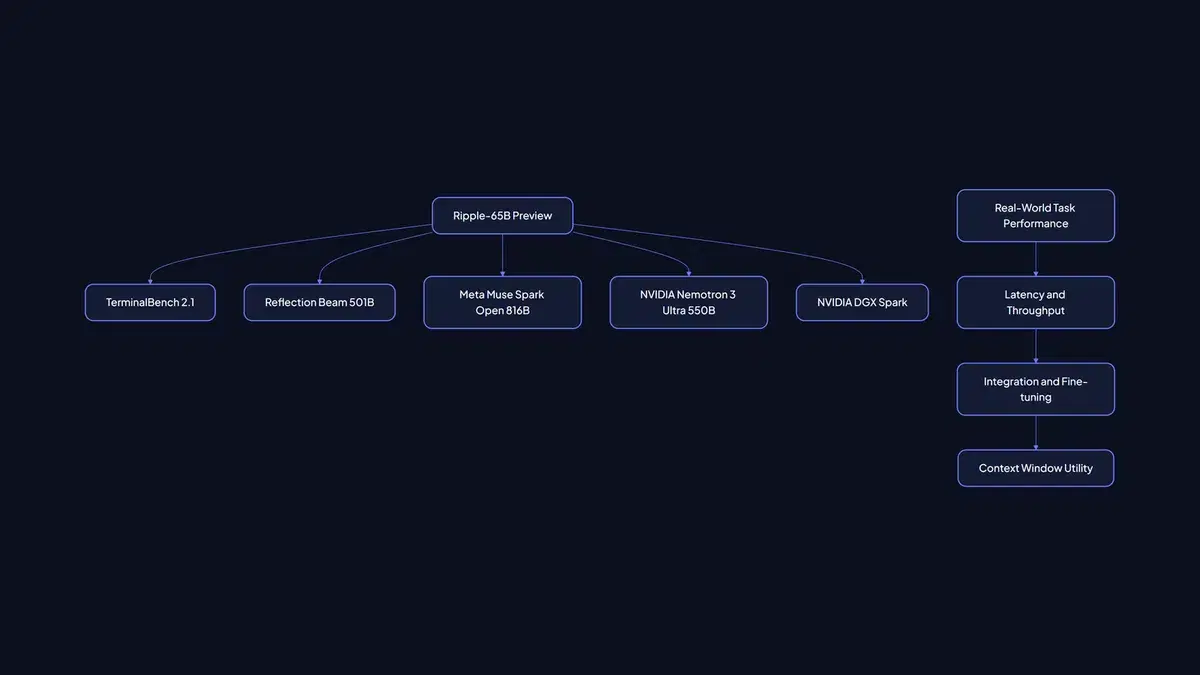
- Ricursive Intelligence positions Ripple-65B Preview as a substantial advancement, particularly in agentic coding benchmarks. They report a TerminalBench 2.1 score of 80.52. This figure, they assert, surpasses larger open-weight models such as Reflection Beam 501B (80.1), Meta Muse Spark Open 816B (76.4), and NVIDIA Nemotron 3 Ultra 550B (56.4). This claim is notable, especially considering their reported training expenditure of $32 million, which they contrast with estimated costs of up to $1 billion for other frontier models. This training cost efficiency warrants consideration from a resource optimization standpoint.
Their architectural selection of a modernized dense Transformer, as opposed to a Mixture-of-Experts (MoE) model, is also significant. They indicate that this design, coupled with a thin-and-deep aspect ratio, facilitated strong performance with a 40% MFU (Model FLOPs Utilization) during training. The reported low-latency token generation and the capability to operate on hardware like NVIDIA DGX Spark suggest a practical deployment focus beyond theoretical metrics. Support for a 1 million token context length is a critical feature for complex coding tasks demanding understanding of extensive codebases.
03Evaluation Framework for Ripple-65B
- While the TerminalBench 2.1 score is impressive, our team approaches such claims with pragmatic scrutiny. Benchmarks provide an initial data point, not a definitive conclusion. We would assess Ripple-65B for integration into our agentic coding pipelines by examining the following:
- Real-World Task Performance: ** TerminalBench offers a useful indicator, but its efficacy on our specific use cases requires validation. We would test the model on proprietary codebases, adhering to our distinct coding standards, for tasks including automated documentation generation, complex refactoring, and security vulnerability identification. A marginal improvement of 1-2 points on a benchmark may not directly translate to production value.
- Latency and Throughput: ** Low-latency token generation is essential for interactive agentic coding. We need to quantify Ripple-65B's performance under load within our operational environment. What are the actual tokens-per-second rates on our standard inference hardware? Does it achieve the responsiveness necessary for an optimal developer experience?
- Integration and Fine-tuning Requirements: ** Evaluating the ease of integrating the model with our existing MLOps infrastructure is critical. Determining the extent of fine-tuning required to achieve optimal performance for our specific domain is also a key consideration. The $32 million training cost applies to the base model; our internal R&D for fine-tuning and deployment will incur additional expenses.
- Context Window Utility: ** The 1 million token context window presents a substantial capability. We must ascertain how effectively the model utilizes this extensive context. Does it demonstrate genuine attention to relevant sections of a large codebase, or does it exhibit context window dilution? Testing with codebases exceeding 100,000 lines will be paramount.
In a recent project, we integrated a new open-weight model into a client's RAG pipeline for code summarization. Despite its high benchmark scores, its actual performance on their internal, highly specialized codebase showed only a marginal improvement over a smaller, established model. The integration effort and the necessity for extensive fine-tuning diminished the theoretical advantages. This experience reinforced the imperative of real-world testing.
04Scenarios Where Ripple-65B May Not Be Optimal
Notwithstanding its promising assertions, Ripple-65B may not represent the ideal solution for all teams or tasks. For requirements centered on basic code completion or boilerplate code generation, a more compact, specialized model might offer greater cost-effectiveness and simplified management. The inherent complexity and potential overhead of a 65 billion parameter model, even one trained efficiently, could prove excessive.
Additionally, teams heavily invested in a specific MoE architecture or operating under strict hardware resource constraints that do not align with the model's serving requirements may find its benefits limited. While open-weight models provide flexibility, they also impose responsibility for infrastructure management, fine-tuning, and ongoing evaluation. For some organizations, a commercially supported API may still present a more straightforward solution, albeit with potentially reduced control or higher per-token costs.
The introduction of Ripple-65B is a positive development for the agentic AI community. It advances the capabilities of open-weight models and underscores the significance of efficient training methodologies. For teams developing sophisticated agentic coding systems, it presents another candidate for rigorous evaluation. The critical step involves moving beyond headline performance figures to conduct detailed, use-case-specific testing to confirm its suitability for specific applications.
05Sources
- [Ripple-65B Preview: U.S. Open-Weight SOTA on Agentic Coding](https://www.ricursive.com/ripple) (ricursive.com)
- [Discussion: Ripple-65B Preview: U.S. Open-Weight SOTA on Agentic Coding](https://news.ycombinator.com/item?id=50369925) (Hacker News)