

01The hardware bottleneck of 2.8T models
- Serving a 2.8T parameter Mixture-of-Experts (MoE) model like Kimi K3.1 Pro requires evaluating memory footprints and infrastructure costs carefully. The architecture features 896 experts and a 1-million-token context window. Standard GPU clusters run out of high-bandwidth memory quickly at this scale.
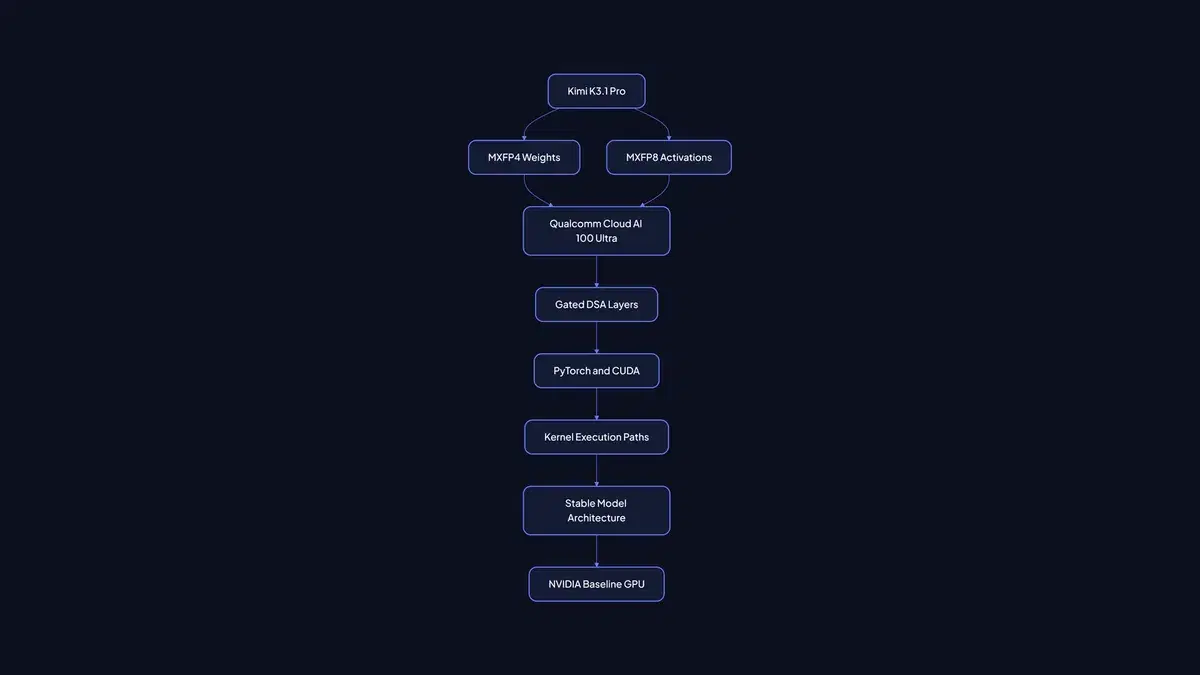
- Benchmarking reveals that Kimi K3.1 Pro relies on MXFP4 weights and MXFP8 activations. These formats require specialized silicon capable of native non-standard precision math. Running these models on general-purpose hardware negates the latency and throughput benefits gained from quantization-aware training.
02Qualcomm Cloud AI 100 Ultra as an inference target
- The Qualcomm Cloud AI 100 Ultra targets inference efficiency. Standard GPU deployments often over-provision general-purpose compute for workloads that are memory-bandwidth bound. The Cloud AI 100 Ultra silicon is designed specifically for the matrix multiplication patterns found in the Gated DSA layers of Kimi K3.1 Pro.
However, migration presents integration challenges. Moving from a standard PyTorch and CUDA environment to Qualcomm's software stack requires rewriting and re-optimizing kernel execution paths. Engineering teams moving fast with frequently changing model architectures will face extended time-to-production cycles.
03Production deployment constraints
Deploying the Cloud AI 100 Ultra makes sense only for teams operating with a stable model architecture. Benchmarking a stable, quantized MoE for an internal service showed a 40% reduction in power-per-inference cost compared to baseline GPU nodes.
This hardware is not a general replacement for NVIDIA
04Sources
- [Kimi K3.1 Pro model weights are out](https: //huggingface.co/moonshotai/Kimi-K3.1-Pro) (huggingface.co)
- [Discussion: Kimi K3.1 Pro model weights are out](https://news.ycombinator.com/item?id=50366999) (Hacker News)