

01The trap of traditional static analysis
Most legacy codebases are graveyards of good intentions. We have all seen the SonarQube reports with 40,000 'code smells' that get ignored by every engineer on the team. The problem with traditional static analysis tools is that they treat all debt as equal. A missing docstring in a legacy utility script is treated with the same severity as a race condition in a core authentication module.
When we audited a client’s monolithic Java application last year, they had three full-time engineers dedicated to 'clearing debt.' They were burning 120 hours a week fixing minor linting errors that had zero impact on uptime or feature velocity. The team was busy, but they were not productive. We stopped that effort immediately.
02Mapping debt to production telemetry
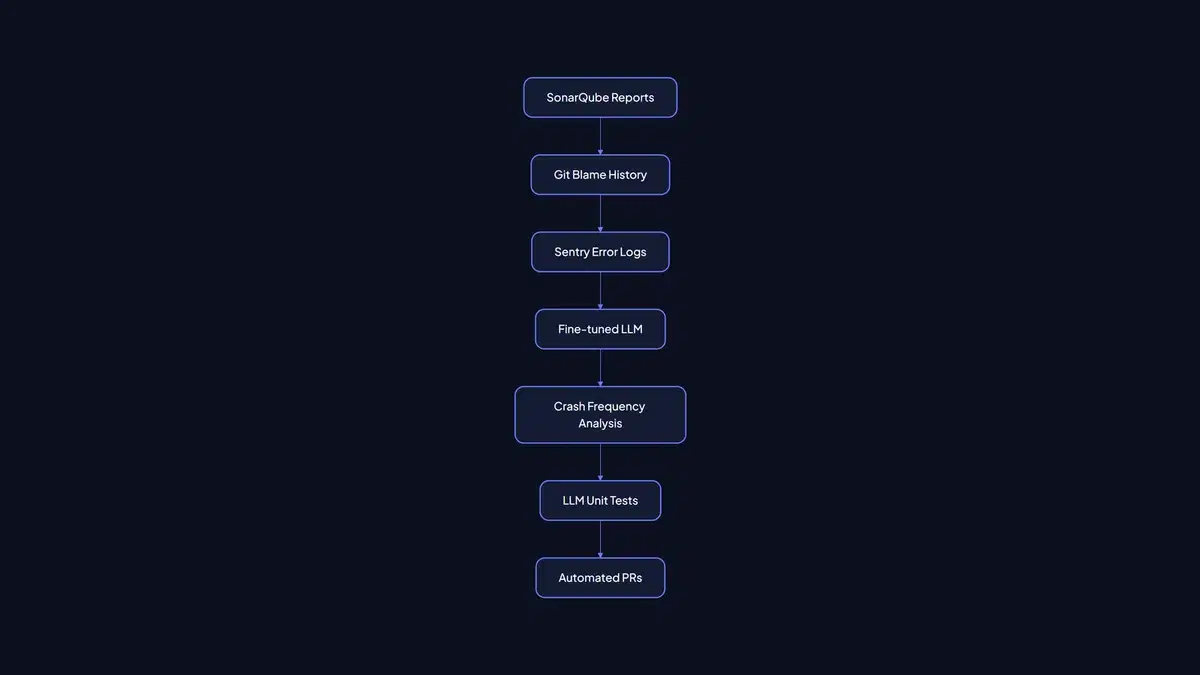
To move the needle, you have to stop looking at code in a vacuum. We started by correlating Git blame history with error logs from Sentry. If a specific module was responsible for 60% of the production 500-errors over the last quarter, that module is your priority. Not the one with the most style violations.
We built a custom pipeline that uses a fine-tuned LLM to ingest these hotspots. Instead of just flagging 'complexity,' the model explains the business risk. It identifies that a specific class is hard to test and is the source of recurring concurrency issues. This shifts the conversation from 'this code is ugly' to 'this code is costing us $5,000 in downtime per month.'
03Practical implementation of AI-assisted refactoring
On a recent project, we automated the refactoring of a legacy Python service. The process followed these steps:
- Identify the top 5% of code files by crash frequency and churn rate.
- Use an LLM to generate unit tests for these files, focusing on the paths that triggered the errors.
- Propose modularization changes through automated PRs, restricted to non-breaking refactors.
We did not let the AI rewrite the entire core logic. That is a recipe for disaster. Instead, we used it to break down massive 2,000-line functions into testable, discrete units. The human engineer only reviews the PR to ensure the logic remains intact.
04Where this fails
AI-augmented analysis is not a magic bullet. It struggles with stateful, highly distributed systems where the debt is architectural rather than syntactic. If your system is failing because of a flawed microservices contract, an LLM will not fix it. It might suggest a cleaner method, but it won't see that the entire service decomposition is the root cause.
Do not use these tools to replace senior engineers. Use them to strip away the noise so your senior engineers can focus on the architectural flaws that actually matter.
What are you currently doing to distinguish between 'annoying code' and 'dangerous code' in your pipelines?